Quick answerOur recommendation in brief
The Samsung HW-Q990F is the strongest recommendation when a complete Atmos package with rear speakers is wanted from the start. Sonos Arc Ultra is the best expandable platform, Bose is the dialogue-focused one-bar choice, Sony makes most sense with a compatible BRAVIA television and Sennheiser provides the compact premium alternative. Room dimensions, eARC compatibility and the cost of the finished system should decide the purchase.
Our top picks at a glance
| Recommendation | Product | Best for | Lowest price | |
|---|
| Best complete surround package | Samsung HW-Q990F (2025 model) | Films, gaming and buyers who want rear speakers immediately | Check current price | View product |
| Best expandable premium soundbar | Sonos Arc Ultra | Mixed TV and music use in a Sonos household | Check current price | View product |
| Best for dialogue clarity | Bose Smart Ultra Soundbar (previous generation) | Television, drama and simple one-bar installation | Check current price | View product |
| Best for compatible Sony TVs | Sony BRAVIA Theatre Bar 9 | Premium Sony televisions and later wireless expansion | Check current price | View product |
| Best compact premium option | Sennheiser AMBEO Soundbar Mini | Smaller rooms and buyers prioritising sound quality over maximum bass | Check current price | View product |
Prices shown may change after you leave MainBuyer.
Best complete surround packageSamsung HW-Q990F (2025 model)
A soundbar, wireless subwoofer and rear speakers are included, giving it the clearest route to enveloping Dolby Atmos without building an AV-receiver system.
Best for: Films, gaming and buyers who want rear speakers immediately
Read review and retailer links Best expandable premium soundbarSonos Arc Ultra
Strong dialogue, room tuning, music services and straightforward expansion with Sonos subs and surrounds make it a polished long-term platform.
Best for: Mixed TV and music use in a Sonos household
Read review and retailer links Best for dialogue clarityBose Smart Ultra Soundbar (previous generation)
AI Dialogue Mode, Dolby Atmos processing and ADAPTiQ calibration make it especially relevant when speech intelligibility is the main complaint.
Best for: Television, drama and simple one-bar installation
Read review and retailer links Best for compatible Sony TVsSony BRAVIA Theatre Bar 9
Its 13-speaker design, 360 Spatial Sound Mapping and BRAVIA integration create the strongest case inside a matching Sony system.
Best for: Premium Sony televisions and later wireless expansion
Read review and retailer links Best compact premium optionSennheiser AMBEO Soundbar Mini
Room calibration and ambitious virtualisation produce a more sophisticated solution than basic compact bars where furniture width is limited.
Best for: Smaller rooms and buyers prioritising sound quality over maximum bass
Read review and retailer links Decide whether you want a bar or a complete system
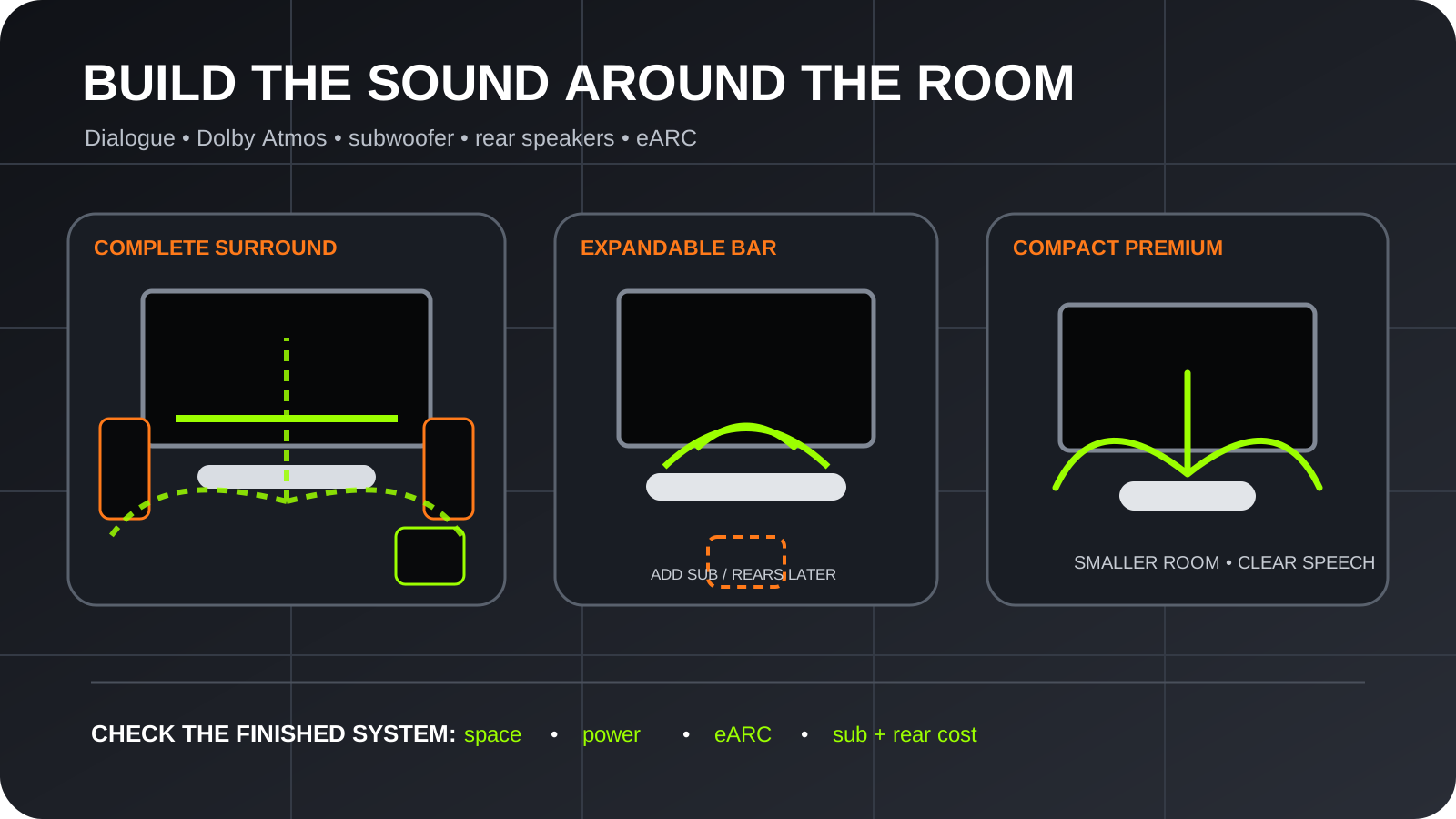
A single soundbar is visually simple, uses one main power socket and avoids placing speakers behind the seating position. It can substantially improve dialogue, tonal balance and soundstage width over television speakers. Virtual surround and upward-firing drivers may add a sense of height, but they cannot place sound behind the listener as directly as physical rear speakers. The Sonos Arc Ultra, Bose Smart Ultra, Sony Bar 9 and Sennheiser AMBEO Mini all begin as one-bar systems, although several can be expanded.
The Samsung HW-Q990F is different because its subwoofer and wireless rear speakers are part of the package. That increases installation work and the number of sockets, but it also removes uncertainty about later upgrade cost. Wireless speakers still require mains power, and rear placement affects the result. Buyers should decide whether they genuinely have suitable positions before paying for a complete surround package.
Dialogue quality is not guaranteed by a high channel count
Muffled speech can be caused by a poor centre-channel balance, room reflections, aggressive film mixes or the television's placement. A dedicated centre driver, clear-voice processing and room calibration can all help. Bose promotes AI Dialogue Mode, Sony combines its processing with compatible BRAVIA television features, and Sonos includes speech enhancement. These modes can improve intelligibility, but very strong processing may make voices sound detached or reduce the natural balance of music and effects.
Before buying, check the television's own audio settings and placement. A soundbar pushed deep inside a cabinet or blocked by the screen may perform badly. Hard floors and bare walls can increase reflections, while a large open room demands more output than a small bedroom. The practical test is whether speech remains clear at the volume you normally use, not how loudly the system can play.
Dolby Atmos depends on the room and the source
Dolby Atmos allows sound objects to be positioned in three dimensions, but the audible result depends on the content, television passthrough, connection and speaker layout. Upward-firing drivers reflect sound from the ceiling, so a flat moderately high ceiling is usually more helpful than a very high, vaulted or heavily absorbent one. Virtualised height can widen the presentation in difficult rooms but should not be confused with physical ceiling speakers.
Streaming services, discs and game consoles do not all use the same audio formats or bitrates. Confirm that the television can pass the desired format through its HDMI eARC port. Some products support Dolby Atmos but handle DTS formats differently. Sony explicitly supports Dolby Atmos and DTS:X on the Bar 9, while other ecosystems may prioritise Dolby. Buyers with a disc collection should check format support rather than assuming every premium soundbar accepts every soundtrack.
HDMI eARC is the simplest high-quality connection
HDMI eARC carries television audio to the soundbar and supports higher-bandwidth formats than older ARC implementations. It also enables volume and power control through HDMI-CEC when the devices cooperate correctly. The HDMI Licensing Administrator describes eARC as a route for high-performance audio to soundbars and home-theatre systems. Use the television port labelled ARC or eARC and the supplied or appropriately certified cable.
A soundbar with only one HDMI eARC socket does not provide passthrough for a console or player. That is acceptable when the television has enough inputs and passes every required format, but it can be restrictive on older sets. Check the number of television HDMI ports, gaming features and whether connecting the bar occupies the only eARC-capable input. Optical audio is a useful fallback for basic television sound but normally gives up advanced formats and some integrated control.
Bass and rear speakers can multiply the final cost
A premium one-bar product may sound balanced alone, but deep film effects usually benefit from a dedicated subwoofer. Optional subs and rear speakers can cost as much as the original bar, so compare the complete desired system rather than the entry price. Sonos and Bose make expansion straightforward within their ecosystems, while Sony offers matching optional speakers and subwoofers. Mixing wireless components across brands is generally not possible.
The subwoofer needs a practical floor position with power and enough ventilation. Bass changes significantly around corners and walls; placing the unit in the most visually convenient spot can produce boomy or weak results. Rear speakers need stable stands or shelves and sensible cable management for their power leads. A complete system is worthwhile only when the room can accommodate it safely.
Room calibration and ecosystem features affect ownership
Calibration measures or estimates how the sound interacts with the room, then adjusts timing and tonal balance. Sonos, Bose, Sony and Sennheiser provide their own approaches, often using a phone or included process. Calibration can correct broad problems and align optional speakers, but it cannot remove physical obstructions or create ideal acoustics in every seating position. Run it after furniture is placed and repeat it after major room changes.
Music playback, multi-room audio, voice control and television integration may determine which platform feels easiest. Sonos is strongest when the household already uses Sonos rooms. Sony adds features with compatible BRAVIA televisions, Samsung offers Q-Symphony with selected Samsung sets, and Bose integrates with its own wireless products. Ecosystem features are useful, but they should not outweigh basic fit, dialogue and connectivity when the soundbar will mainly serve one television.
Measure the television stand, wall and screen clearance
Premium bars are wide and can block a low-mounted television's infrared receiver or lower edge. Measure width, height and depth, including the space needed for upward-firing speakers to breathe. A shelf directly above an Atmos bar can obstruct height effects. Wall mounting may solve furniture conflicts but requires suitable fixings, cable routes and awareness of the bar's weight.
Match scale to the room rather than simply matching the television brand. The compact Sennheiser makes more sense in a smaller installation than the Samsung package, while the Bar 9 and Arc Ultra need enough width to create their intended presentation. Also check ventilation and avoid placing decorative objects in front of drivers. A clean installation improves both usability and sound.
What to consider before buying
- Confirm the television has HDMI eARC and can pass the audio formats you use.
- Measure the soundbar height so it does not block the screen or remote sensor.
- Price the desired subwoofer and rear speakers before committing to an ecosystem.
- Check mains sockets at every proposed speaker and subwoofer location.
- Use a complete surround package only when physical rear-speaker placement is realistic.
- Compare dialogue modes and return terms because speech preference is personal.
Frequently asked questions
Is a soundbar with Dolby Atmos worth it?
It can be when the television, source and room support the feature. Atmos bars usually offer a larger presentation, but ceiling shape, speaker placement and content affect the result. Clear dialogue and balanced sound remain more important for everyday use.
Do I need a subwoofer with a soundbar?
Not always. Many premium bars provide adequate bass for television and music, especially in smaller rooms. A subwoofer adds deeper impact for films and games but increases cost, floor space and the risk of disturbing neighbours.
Are wireless rear speakers completely wireless?
Usually not. They receive audio wirelessly but still require mains power, and some systems use a small amplifier module connected by speaker cable. Check the exact installation before assuming no cables are needed.
Can I use any subwoofer with a soundbar?
Generally no. Wireless soundbar subwoofers and surrounds are normally tied to the same brand and supported product family. Standard third-party subs rarely pair directly unless the soundbar provides a conventional subwoofer output.
Is eARC better than optical audio?
Yes for modern premium systems. eARC can carry higher-bandwidth formats and supports integrated HDMI control. Optical remains useful for basic stereo or compressed surround when the television lacks a compatible HDMI connection.
Evidence and methodologyHow this guide was prepared
This guide uses official specifications, manufacturer guidance, retailer model information and MainBuyer editorial judgement. It explains trade-offs rather than claiming one product is right for everyone, and it does not describe research-based assessments as hands-on tests.
See how we review, our editorial policy and corrections policy.
Last editorial review: 2026-07-14
SourcesResearch references